
Magnesium bath · 9 min read
How much magnesium flakes per bath? Grams by tub size, worked out
Pack directions say "a cup" or "a handful", but baths range from 65 to more than 200 litres. Here's the maths, from published tub volumes and makers' own directions.
Quick answer
Most makers suggest about 250 g of magnesium flakes (roughly two cups of flakes) for a full bath. Our soak's directions are 100–200 g (2–4 scoops), depending on your tub. An average Australian bath holds about 110 litres, so that's around 2.3 g per litre. Use less in a shallow bath, a little more in a deep one, and weigh it rather than guessing.
On this page
- How much magnesium flakes should you put in a bath?
- How much water is actually in your bath?
- What does 250 g work out to, per litre?
- Why is a cup of flakes not the same as a cup of Epsom salt?
- How much Epsom salt goes in a bath, by comparison?
- Is more magnesium flakes in the bath better?
- How much should you use for a foot soak?
- How many baths do you get from a 1 kg pouch?
- How do you dissolve magnesium flakes properly?
How much magnesium flakes should you put in a bath?
Around 250 g for an average full bath. That's the figure on most flake packs. For our bath soak we suggest 100–200 g per bath (2–4 scoops, about 1 to 1½ cups), depending on the size of your tub.
The UK flake brand BetterYou says to add 250 g of its magnesium flakes, "roughly 2 cups", per bath (BetterYou). The US company Enviromedica suggests 1–3 cups of its Zechstein flakes in a full tub (Enviromedica). Our Magnesium Flakes + Epsom Bath Soak says to dissolve 100–200 g (2–4 scoops) in a warm bath, once or twice a week.
Those directions all assume a "normal" bath. The trouble is that baths aren't normal. A half-filled tub and a deep soak to the overflow can differ by more than 100 litres, so the same 250 g can feel quite different from one bath to the next. That's what the rest of this guide sorts out.
How much water is actually in your bath?
Less than you'd think. Australian water utilities put an average bath at 100–140 litres, and UK research puts typical use at 65–100 litres, depending on the tub.
Here's what the published figures say:
- Sydney Water: an average bath uses 110 litres (Sydney Water).
- SA Water: 120 litres per filled bath (SA Water).
- South East Water (Melbourne): 140 litres for a full bath, 80 litres for a half bath (South East Water).
- Waterwise (UK): a typical bath uses about 80 litres. Its 2009 report, using Market Transformation Programme figures, says standard baths hold 225 litres to the overflow but people actually use about 88 litres, with 65 litres for undersized and corner baths and 100 litres for shower baths (Waterwise).
- US EPA: a full bathtub can take up to 70 gallons, about 265 litres (EPA WaterSense).
The gap between "capacity" and "actual use" is the useful bit. Nobody fills a tub to the overflow with a person in it. Your body takes up a good share of the space, so most real baths sit somewhere between 80 and 140 litres of water.
What does 250 g work out to, per litre?
About 2.3 g per litre in an average 110-litre Australian bath. In a shallow 80-litre bath it's closer to 3 g per litre; in a deep 140-litre bath, nearer 1.8 g.
We worked this out by dividing 250 g by each of the published bath volumes above. The last column shows how many grams you'd need to keep the same strength as 250 g in Sydney Water's 110-litre average bath (about 2.27 g per litre), rounded to the nearest gram.
| Bath (source) | Water | g per litre at 250 g | Grams for the same strength as an average bath |
|---|---|---|---|
| Undersized or corner bath, actual use (Waterwise) | 65 L | 3.8 g/L | 148 g |
| Half bath (South East Water) / typical UK bath (Waterwise) | 80 L | 3.1 g/L | 182 g |
| Standard UK bath, actual use (Waterwise) | 88 L | 2.8 g/L | 200 g |
| Average bath (Sydney Water) | 110 L | 2.3 g/L | 250 g |
| Filled bath (SA Water) | 120 L | 2.1 g/L | 273 g |
| Full bath (South East Water) | 140 L | 1.8 g/L | 318 g |
| Very large tub, filled (US EPA maximum) | 265 L | 0.9 g/L | 602 g |
Use this as a guide to feel, not a recipe. There's no evidence that a particular number of grams per litre does anything special. What changes is how the water feels: a stronger bath tends to feel silkier and leaves a little more of a salty film on your skin.
For perspective, seawater averages about 35 g of dissolved salts per litre (Wikipedia). An average magnesium bath at 2.3 g per litre is roughly a fifteenth as salty as the sea.

Why is a cup of flakes not the same as a cup of Epsom salt?
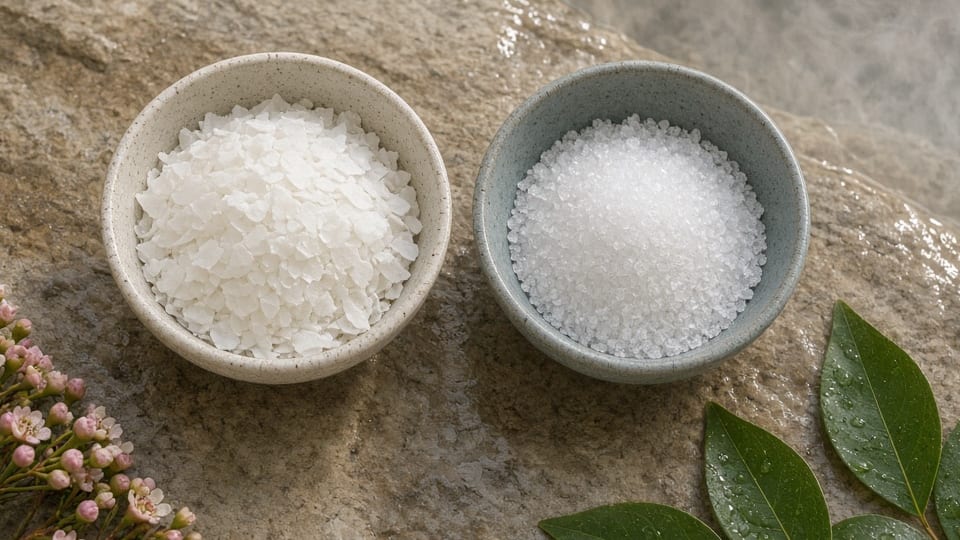
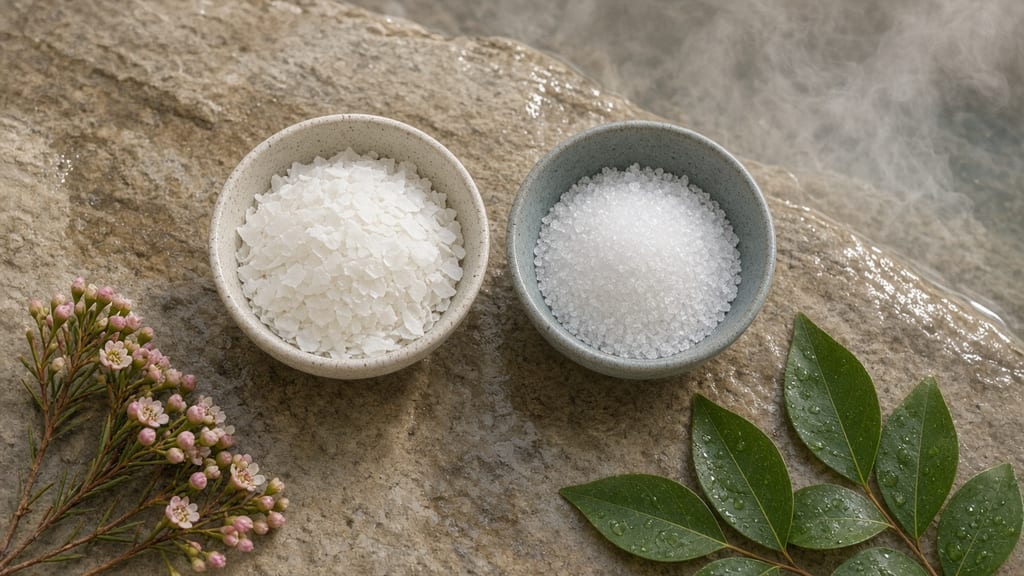
Because flakes are light and airy, while Epsom salt crystals pack tightly. A cup measures volume, not weight.
BetterYou puts 250 g of its flakes at roughly two cups (BetterYou). Granular Epsom salt and fine salt crystals settle into a cup with far less air between them, so the same cup holds more grams. Cup sizes vary too: an Australian metric cup is 250 mL, while a US cup is about 240 mL (Wikipedia)).
That's why we'd rather you think in grams. The easy fix:
- Weigh it once. Put a mug or scoop on the kitchen scale, zero it, and pour in salts until it reads 250 g.
- Mark the level. Note where 250 g comes to, or keep that mug with the salts.
- Adjust by eye after that. Use a bit less for a shallow bath and a bit more for a deep one, using the table above.
This matters most with blends. A soak that mixes flakes with Epsom salt, like ours, will weigh more per cup than flakes on their own.
How much Epsom salt goes in a bath, by comparison?
The Epsom Salt Council suggests two cups of Epsom salt in a standard-sized bathtub (Epsom Salt Council).
So flakes and Epsom salt end up in a similar range for a full bath: about two cups either way. But because a cup of Epsom salt is denser, two cups of it weigh more than two cups of flakes. If you're swapping one for the other, swap by weight and see how the water feels. The two salts feel quite different in the bath, which we cover in magnesium flakes vs Epsom salt.
| Product or source | Suggested amount for a full bath | How often |
|---|---|---|
| BetterYou Magnesium Flakes | 250 g (roughly 2 cups) | 2–3 times a week |
| Enviromedica Zechstein flakes | 1–3 cups | Not stated |
| Epsom Salt Council (Epsom salt) | 2 cups in a standard tub | 3 times a week, 12 minutes or more |
| WHOOSA Flakes + Epsom Bath Soak | 100–200 g (2–4 scoops) | Once or twice a week |
Is more magnesium flakes in the bath better?
No proven benefit comes from adding more. Extra flakes mostly mean a more slippery tub, more salt left on your skin, and a pack that runs out faster.
Some flake brands suggest very large amounts for an "intensive" soak. The research behind magnesium through the skin is small and inconclusive (Gröber et al., 2017), so we don't claim that more flakes do more for you. If you enjoy a silkier, saltier bath, go up a little. If your skin feels tight or dry afterwards, go down a little and rinse off when you get out.
Bath magnesium also isn't counted toward the official upper limits for magnesium, which apply to what you swallow. We cover the daily amounts and limits country by country in can you have too much magnesium?
How much should you use for a foot soak?
Much less in total, because a basin holds only a few litres. BetterYou suggests 150 g of flakes in about 5 litres of water, enough to cover your feet (BetterYou).
That works out to 30 g per litre, a much stronger solution than a full bath. If that feels like too much on your skin, there's no reason not to start lower. Even a small handful in a basin gives you a mineral-soft feel. Soak for 10–15 minutes, pat your feet dry, and smooth on a body butter while your skin is still warm. If you prefer a spray to a soak, see how to use magnesium spray on your feet.
How many baths do you get from a 1 kg pouch?
Five to ten baths at our suggested 100–200 g. At 150 g in a standard bath, that's six baths: about six weeks once a week, or three weeks twice a week.
| Your bath | Grams per bath | Baths per 1 kg | A 1 kg pouch lasts |
|---|---|---|---|
| Small tub or kids | 100 g (2 scoops) | 10 | 10 weeks, weekly |
| Standard bath | 150 g (3 scoops) | 6 | 6 weeks, weekly |
| Deep soaker | 200 g (4 scoops) | 5 | 5 weeks, weekly |
| Standard bath, twice a week | 150 g (3 scoops) | 6 | 3 weeks |
Cost per bath is simply the pouch price divided by the number of baths. At our Australian price of A$44.95, six standard baths come to about A$7.49 each, or about A$6.66 each on Subscribe & Save.
How do you dissolve magnesium flakes properly?
Add them under the running tap as the bath fills. Flakes dissolve almost at once in warm water; Epsom salt and blends may need a quick stir.
- Run the bath warm, not hot. Comfortable enough that you can stay in for 15–20 minutes.
- Measure your salts. 100–200 g (2–4 scoops) of our soak, depending on your tub.
- Pour them under the tap. The moving water dissolves them fastest.
- Swish the bottom. Check by hand that nothing's sitting undissolved on the floor of the tub.
- Soak, then rinse. A quick rinse, pat dry, and a body butter while your skin is warm.
Keep the pouch sealed and out of the steamy bathroom between baths. Magnesium chloride draws moisture from the air and clumps if left open (PubChem). Clumped flakes still dissolve fine; just break them up first.
FAQ
How many grams of magnesium flakes per litre of bath water?
At the common 250 g dose, about 2–3 g per litre in a typical 80–120 litre bath. In an average 110-litre Australian bath it's about 2.3 g per litre.
How many cups of magnesium flakes in a bath?
About two cups of flakes is around 250 g, according to BetterYou. Because cups measure volume, weigh 250 g once and mark your cup or scoop.
Can I put too many magnesium flakes in a bath?
You can make the bath saltier and the tub more slippery, but there's no evidence that more flakes do more. If your skin feels tight afterwards, use less and rinse off.
How much Epsom salt should I put in a bath?
The Epsom Salt Council suggests two cups of Epsom salt in a standard-sized bathtub. Two cups of Epsom salt weigh more than two cups of flakes.
Should I use less magnesium in a half bath?
Yes, if you want the same feel. A half bath of about 80 litres needs about 180 g to match 250 g in an average 110-litre bath.
How long does a 1 kg bag of magnesium flakes last?
About four full baths at the common 250 g dose. At our soak's 100–200 g, it's five to ten baths.
Last updated 27 October 2026
WHOOSA products are cosmetics, for use on the outside of the body only. Article images are AI-generated ingredient studies; product images are design concepts.
Keep reading
Magnesium flakes vs Epsom salt for the bath
Magnesium flakes are magnesium chloride; Epsom salt is magnesium sulfate. How they differ in feel, dissolving and use in the bath, and why we blend both.
Can you have too much magnesium? Daily amounts, upper limits and what the research says
How much magnesium you need by age and sex in Australia, NZ, the US, Canada, the UK and South Africa, the upper limits for supplements, and signs of too much.